



In S/4HANA, the architectural backbone of accounting has been reimagined through the Universal Journal (ACDOCA). While the old world relied on data redundancy across various secondary tables to ensure performance, S/4 HANA utilizes the speed of the HANA in-memory database to aggregate data on the fly.
What Happened to the Secondary Tables?
You might notice that tables like BSID, BSIK, BSIS and BSAS are still “visible” in the system. However, these are no longer physical tables where data is stored twice. They have been replaced by Compatibility Views.
When you run a legacy report, the system redirects the query to ACDOCA. This ensures that your custom ABAP programs still work, but you no longer have to worry about reconciliation between the line item tables and the General Ledger.
Key Changes in Account Management
The biggest “breaking change” for consultants moving from ECC to S/4 HANA is how we define account behavior. The old checkboxes in FS00 have largely been superseded by the G/L Account Type.
- Line Item Display: In S/4HANA, the “Line Item Display” flag is effectively obsolete for most accounts. Because all transactions are written to the Universal Journal, the system records line items by default.
- Open Item Management (OIM): This is still a critical setting, but it is now strictly governed by the account’s purpose. For example, you cannot have a “Secondary Cost” account with Open Item Management.
- The New “Clearing Specific to Ledger”: S/4 HANA introduces the ability to manage open items at the ledger level, which was a significant pain point in ECC for companies using different accounting principles (like IFRS vs. Local GAAP).
New Transactions for the New Era
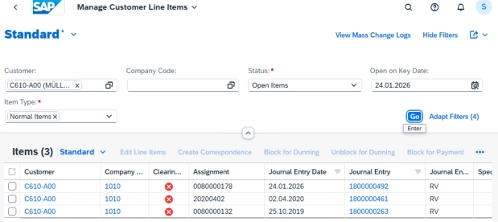
While the classic FBL*N transactions still function, SAP has introduced “H” (HANA) versions and Fiori apps that provide much deeper insights and faster filtering.
| Object | Classic Transaction | S/4 HANA Fiori App / New Transaction |
| Customers | FBL5N | Manage Customer Line Items |
| Suppliers | FBL1N | Manage Supplier Line Items |
| G/L Accounts | FBL3N | FAGLL03H (G/L Line Item Browser) |
Summary for the Transition
The move from ECC to S/4 HANA simplifies the data model by removing the need for index tables. For the end-user, the experience remains familiar, but for the functional consultant, the focus shifts to defining correct Account Types.
Want to know more? Get in touch with us for a free consultation now!
Related Posts

The Evolution of Risk: Credit Management in SAP ECC vs. S/4HANA
The Shift to the Universal Journal – Part 2